Monday, March 10, 2008

Bud Selig Makes How Much?


I never thought how much Bud Selig, the Commissioner of Baseball makes, but according to the business of baseball blog he made 14.5 million dollars last year (link). That was the salary earned by Vlad Guerrero, Lance Berkman, and JD Drew. That salary was topped by only 13 players (including 5 Yankees). He’s getting a 4% raise this year and will make over 15 million next year too.

So next time you feel like booing Alex Rodriguez for his 25 million dollar contract, make sure to boo Bud Selig too. Actually I don't boo anyone for high salaries, I boo A-rod, because he is a Yankee and Bud Selig for black out restrictions, the 1994 strike and I heard he puts ketchup on his brat.

h/t baseballthinkfactory.org

$11,000 Coffee Maker,! How much for the coffee? The Clover Coffee Maker.

How much do you think a cup of coffee would cost from a new $11,000 coffee maker on the market, the Clover? You might think a lot, but as the Economist Magazine points out the Clover costs about as much as the typical espresso machine found in a coffee shop. Given this description in Slate it sounds like it takes about as much work to make a cup of coffee in a Clover as it does to brew an espresso. So the costs are similar to an espresso drink so given the plethora of coffee shops the price should approach costs or price of espresso drinks. So not surprisingly coffee from the Clover goes for $3.50 a cup.

But if you pay $3.50 a cup for clover coffee and $1.75 for a regular non-clover cup, there must be something different between the two. In the description of the Clover it seems the real key is the ability to control the coffee making process so the same great cup of coffee can be made each time. This allows coffee shops to use high end beans and distinguish the difference between regular beans.

It looks like (link) Alexandria’s Grape and Bean is the first DC area coffee shop to get one. Perhaps a field trip is in order.

Thursday, March 6, 2008

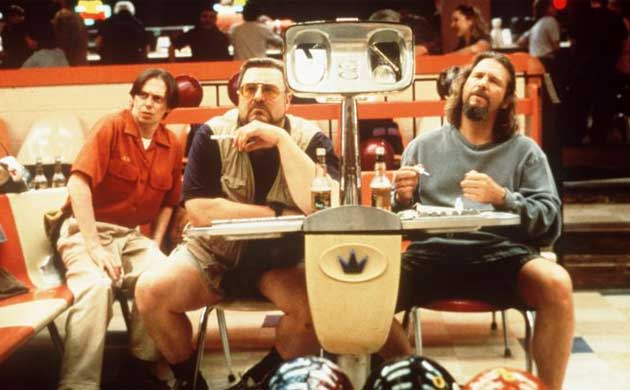
The Dude Never Bowled Alone: Social Capital from Walter and Donny


I didn’t quite make it over to the AFI for tonight’s showing of the Big Lebowski. Instead I was surfing the internet and drinking some beer. I was reading Lazy Man and Money a good personal finance website. Like our friend from the Big Lebowski, the Dude, Lazy Man likes to take it easy for all us sinners. In a recent post Lazy Man was talking about how he just learned about Social Capital. I guess I had taken it for granted everyone knew what social capital meant, but I hang out with too many economists.

Social Capital is a term that came on to my and most social scientists’ radar screen after Robert Putnam’s book “Bowling Alone.” The argument in the book was Americans were participating in fewer clubs like bowling leagues, churches, elks, moose, masons, Kiwanis, varmints … what have you. Unlike the Dude many Americans were moving from leagues to Bowling Alone from Putnam’s website.

“We are bowling alone. While a record number of Americans bowl today, bowling in organized leagues plunged 40 percent from 1980 to 1993. Lest you think this a trivial factoid, over 25% more Americans (91 million) bowled once or more in 1996 than voted in the 1998 congressional elections.”

By not bowling in Leagues people we are very unDude like, we do not have friends like Walter and Donny to call on when Germans demand a ransom from us or someone steals our car. The dude even used his social capital with his land lord gained by going to his performance to tied him over until he could pay rent.
For those of you not familiar with the Big Lebowski or Social Capital: From a seminar series on social capital related to Putnam’s book here is a quick primer on social capital (full link). If you haven’t seen the Big Lebowski go do it.

What does “social capital” mean?
Social networks have value – that is the central premise of social capital. Social capital refers to the collective value of all “social networks” [who people know] and the inclinations that arise from these networks to do things for each other [“norms of reciprocity”].
How does social capital work?
The term social capital emphasizes not just warm and cuddly feelings, but a wide variety of quite specific benefits that flow from the trust, reciprocity, information, and cooperation associated with social networks. Social capital creates value for the people who are connected and – at least sometimes – for bystanders as well. Social capital works through multiple channels:
a) information flows (e.g. about jobs, AIDS, college, etc.) depend on social capital
b) norms of reciprocity (mutual aid) are dependent on social networks.
• Bonding networks sustain particularized (in-group) reciprocity.
• Bridging networks sustain generalized reciprocity.
c) Collective action depends upon social networks (e.g., the role that the black church played in the civic rights movement) although collective action can also foster new networks.
d) Broader identities and solidarity are encouraged by social networks that help translate an “I” focus into a “we”.


Wednesday, March 5, 2008

Pass This Test Win $50

Most of my research deals with conditional cash transfer programs in Latin America. These programs pay households if their children go to school and the family goes to health clinics. In the ones I have studied these incentives increase school enrollment between 5-20% and do all sorts of other great things.


The programs have worked so well that New York City has adopted them (link). However, New York city has added an extra wrinkle. In the US most kids go to school, but many do not achieve what they should. So Ronald Fryer, a Harvard Economist, helped design a program that paid kids money if they passed tests. Seems like the kids are liking the rewards according to this New York Times article.

Dr. Fryer has an interesting story in his own right from juvenile delinquent to Harvard professor in about 10 years.

Baltimore is giving the pay to pass option a chance too (link).


It is too early to tell if these programs in New York and Baltimore have worked as well as the conditional cash transfer programs, but it is worth a shot.
One final thought, the reason the successes of programs in Latin America has been so clear is they have been run as experiments, where half of children receive the program and half don’t (usually separated by communities).

Why get a Ph.D. in Economics?

One take from Andrea Waddle, a first year University of Pennsylvania graduate student, talks about a passion for international development fostered from living in Bolivia. But many other fields study economic development (Sociology, History, Anthropology, and Political Science). Dani Rodrik, a Harvard Economist, chose Economics over Political science based on this epiphany (link)


“One day in the library, I picked up copies of the flagship publications of the two disciplines--the American Political Science Review and the American Economic Review--and put them side by side. One was written in English, the other in Greek. I thought that if I did a PhD in economics, I would be able to read both journals, but that if I did a PhD in political science, it would be goodbye economics.”


I think a similar thought went through my head. Although there is a large opportunity cost to learning all the Greek (i.e. Math) associated with Economics. Is it worth it? Perhaps to help people the best route is a Masters in Public Policy. Chris Blattman, a student of Rodrik’s compares, masters programs with Ph.D.

I agree with Blattman, if you want to be a professor get a PhD. If not try a masters program and see what you think.

Tuesday, March 4, 2008

Homeromics: Learning Economics Through The Simpsons

Homer Simpson teaches us many economic lessons. One of my favorite comes from this exchange:

[Homer is looking for a lost peanut under the couch]
Homer : Aww, twenty dollars. I wanted a peanut!
Homer’s Brain: Twenty dollars can buy many peanuts!
Homer : Explain how.
Homer’s Brain: Money can be exchanged for goods and services.

Or Homer’s apparent lack of understanding of opportunity cost in the grease episode, where he spends all day collecting grease to earn a few dollars but loses out on his work pay check.

I was thinking of all this while reading a paper on using the Simpsons to teach economics. The paper is written by Josh Hall a prof. at Beloit College. Josh has commented on my blog a few times, so I hope he’s still reading, it’s a good paper for economists and non-economist alike.

The Paper is Linked Here:

Monday, March 3, 2008

Scrabulous and Scrabble: Substitutes?

I was playing Scrabble last night with a couple of friends. It turns out many people are playing Scrabble on Facebook too, only I didn’t know this since I’m one of 5 people my age not on Facebook. Two Indian Scrabble lovers, Jayant and Rajat Agarwalla, created an on-line version of Scrabble called Scrabulous. They then turned it into a Facebook application now they have 2.3 million users a month and bring in $25,000 a month is ad sales.

So of course now Scrabulous is being sued by Hasbro makers of Scrabble for copy right infringement. In terms of copy right as lawyer, Jeremy Hertzog , put it “They'd [Jayant and Rajat Agarwalla] have to show that there is some risk the average person would likely confuse Scrabble and Scrabulous, and my instinct is there would be such confusion,"

Copy right law is best left to lawyers. But after reading the comments on the linked blog entry, I can’t help but wonder if more people buy Scrabble board games after playing it on line, or are people buying fewer Scrabble board games since they can play online for free. The comments suggest that it is the first explanation. Or in other words there is no substitute for playing real Scrabble with your friends on a Sunday night.