Wednesday, February 9, 2011

How to tell if someone is poor or will sleep with you on the first date?

In this case I'm thinking of two very different situations. First, international development program often want to target funds to those most in need so they need some way to indentify who should receive aid. A program could just ask people their income, but then there would an incentive to lie in order to meet the criteria to receive funds. Instead programs like conditional cash transfers often use a proxy means test. In a proxy means test program staff visit a house and see if it has indoor plumbing, a cement floor, a TV, a car ect. to see if the family actually needs the money. It doesn't work perfectly to figure out who needs the money perhaps a family was once relatively well off and had plumbing and a cement floor, but was now starving. If done right proxy means testing is pretty close and harder to fake how well off you are.


So totally unrelated, except for the fact that this is also a discussion of related things. But OK Cupid (a dating website), uses their data to see what answers to questions correlate well with others. When asking a potential mate if they like beer, they find "No matter their gender or orientation, beer-lovers are 60% more likely to be okay with sleeping with someone they've just met"

This could be a valuable question, because no one would mind being asked if they liked beer, but asking about sleeping with someone on the first date probably sends a bad signal and you might not get a truthful answer. On the other hand if everyone discovers the signal, then people may lie about their preferences in order to avoid sending the wrong signal.

Read more from OK Cupid here.


Bookmark and Share

Tuesday, February 8, 2011

Welcome Greg Mankiw Blog Readers

In part I was inspired to write this blog, by Mankiw so I hope you enjoy such posts serious posts as (Will Mexican and Brazilian Programs Work Elsewhere) and (How to Help Mexican Coffee Farmers).

If you still feel a holiday spirit try the Economics of Festivus or get ready for Passover


I hope you consider subscribing to my google feed or joining my Facebook group.


Bookmark and Share

Monday, February 7, 2011

Why Greg Mankiw shovels snow off of his roof?

Greg Mankiw is the author of one of the leading intro to econ text books, and like any intro to econ book he discussed comparative advantage. In short comparative advantage shows you can be better off if you do what you're best at. So instead of shoveling snow off of his roof, Mankiw should spend an extra hour consulting and make $500 and pay someone $100 to shovel snow off of his roof. Yet Mankiw last week was up on his roof shoveling snow, despite his worries he might fall off an injure himself (he wasn't worried about dieing as much since he had life and not disability insurance)

Few people hire someone to do everything for them, most people cook their own food, wash their own clothes, and spend time with their children even though many people could earn more working extra. The basic theory doesn't include a few things.

1. People on salary might not be able to earn a few extra dollars to make trade offs.
2. After a certain number of hours working is less fun, even things like being an economist. We do get utility from cooking our own dinner, so at some point we might like to do things ourselves
3. Transaction cost are high, I could hire someone to do my laundry, but either I would have to take it somewhere, a pain, or pay more to get it picked up and delivered.

But I think Mankiw still would have not been influenced by 1-3. In short, I think Mankiw just couldn't find anyone to hire. He was worried about his roof collapsing and in the snow storm most crews were over booked (although they should probably raise their price then) or might not get to the Mankiw residence in time.

Bookmark and Share

Thursday, February 3, 2011

Is it more expensive to have a son or daughter?

Reader Brett, posed the question to me does it cost more to have a son or daughter. I have a 14 month old daughter, so I'm starting to gather data. This paper by Lunberg and Rose attempts to answer that question by looking at how households with one daughter or son spend money. In short they find for most things spending is the same. However, families with sons live in bigger houses and spend more on personal care services (eg hair cuts), while families with daughters spend more on clothes.

The conclusion of the paper of the paper tries to figure out the results for boys, since the girls results seemed pretty intuitive. The authors argue that perhaps boys need more space or that families want to have boys live in better neighborhoods to avoid risk. They also suggest mom spends more on hair cuts because in their words "This result suggests some redistribution from fathers to mothers, and is consistent with the hypothesis that boys directly increase their father’s utility, relative to girls."

I'm surprised Lundberg writes after seeing this, I'm not sure her husband could be much happier.


Bookmark and Share

Wednesday, February 2, 2011

Engel's Law and Inflation: Food Prices Hurting The Poor


The above chart is from Business Insider it shows what percentage of the CPI is made up of food. The CPI is a measure of prices based on what the average consumer buys, economists call the things the average consumer buys a basket of goods (or basket for short). So an American basket would include some food, clothes, a house, a car, ect. an Indian basket would include a higher percentage of food, because Indians spend a higher percentage of their income on food. This is not surprising since we know the average Indian is poorer than the average American and poorer people spend a larger percentage of their budget on food. Economists refer to the relationship between the percentage of budget spent on food and income as Engel's Law (see the below chart)


h/t to Newmark's Door, which also asks why Argentina has such a high percentage given their relative wealth. I'm not sure why either, but my guess would be Argentines spend a larger percentage of their income on food then we would expect given their income, how else are you going to get all that beef.

Returning to yesterday's post my Dad asks for my cheap wine picks. Malbec is the way to go. Frontera can be found for $5. I also drink Yellow Tail (Australian)* and Rex Goliath (California) for their reds and Chateau Ste. Michelle (Washington) for Rieslings. Make a mixed case of these wines and it seems to go well.


* correction Yellow Tail is Australian, which should be easy to remember with the kangaroo on the label.
Bookmark and Share

Tuesday, February 1, 2011

Wine Inflation: 2 buck chuck is now 4 bucks?


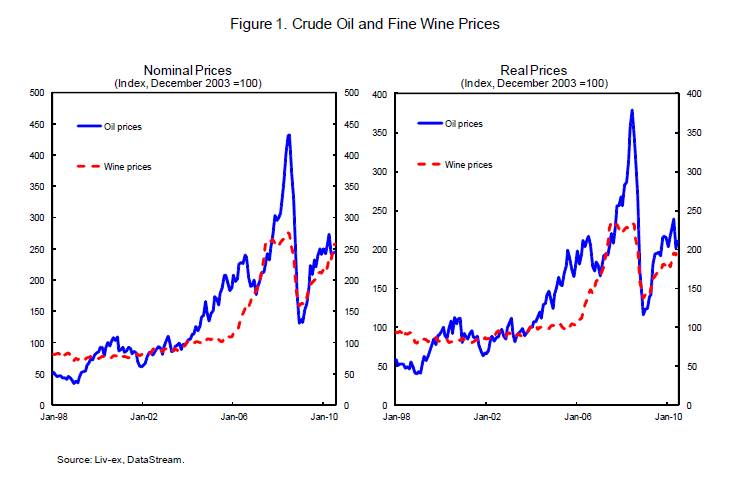
The wine economist has a recent post on wine price inflation. Linking to a recent paper by two IMF economists that suggests like rising oil prices the increasing wine prices are due to growing demand for emerging economies like the BRIC countries (Brazil, Russia, India, and China). As the graph above shows the price of oil and wine move together.

The wine economist suggests this might be due to the quality of wines in BRIC countries which aren't that good, although there are some surprises.

So in an effort to stimulate exports of wine to China, President Obama served visiting Chinese president Hu some fine America wines.

All that said, I find now that I have a handful of $5-7 wines I like, I'm spending less money on wine.


Bookmark and Share

Monday, January 31, 2011

Bad Ideas for Budget Problems at Universities

This weekend Scott Adams (creator of Dilbert) in the Wall Street Journal proposed several what he called bad ideas to get wealthy people to support higher taxes on higher income brackets. He proposed bad ideas, because bad ideas can spur good ones (read his example about monkey helicopter pilots). So his bad ideas for higher taxes the rich get, free use of the carpool lane, to cut in line at the DMV, a thank you letter from welfare recipients, and to vote twice in any election. Again problems with all of these ideas, but perhaps from the bad can come good.

So in the spirit of bad ideas, I propose a few to help university budget situations. Schools like mine, Towson, are generally getting less funding from the state and haven't been able to raise tuition due to legislative mandate.

So again I necessarily don't support any of these ideas, they are merely to help develop good ideas. We could think of these individually or package them for any student who pays double tuition. I'm aware that universities already charge students different prices, but these are crazier (worse) ideas


Bad Ideas For Students:
1. Like the carpool lane idea, I propose we sell faculty parking passes to students, but at 3 times the cost that faculty to pay. At Towson, students often spend 15-30 minutes looking for parking, so even a $2,000 parking pass may look enticing to some.
2. A faculty member at another school told me that someone proposed he participate in an auction, where a faculty member would change one grade on the student record. The faculty member refused to participate, so bad idea. A less bad, but still bad idea might be to let students skip one required class.
3. If some students could save a semester by getting into the right classes, they may be willing to pay more to register early.
4. The alumni office declares an amount of donation it would like from the student body (say $100,000 or $5 a student) if it reaches that goal one day of class is canceled.
5. Have students in majors or colleges with higher demand (like the business) pay more (although this has been proposed at other places)


Bad Ideas for Faculty
1. Ditto for more money better parking.
2. How about a faculty member can pay a fee to have a student dropped from their class (bad idea)
3. In each department an auction is held the winning faculty member gets their choice of schedule.
4. If the faculty donate more (or 2x as much) than the class day is not canceled.


College President
1. Listen to any of the above advice

So what are your bad ideas?
Bookmark and Share